Townsville & surrounding areas
Mobile Mechanic in Townsville
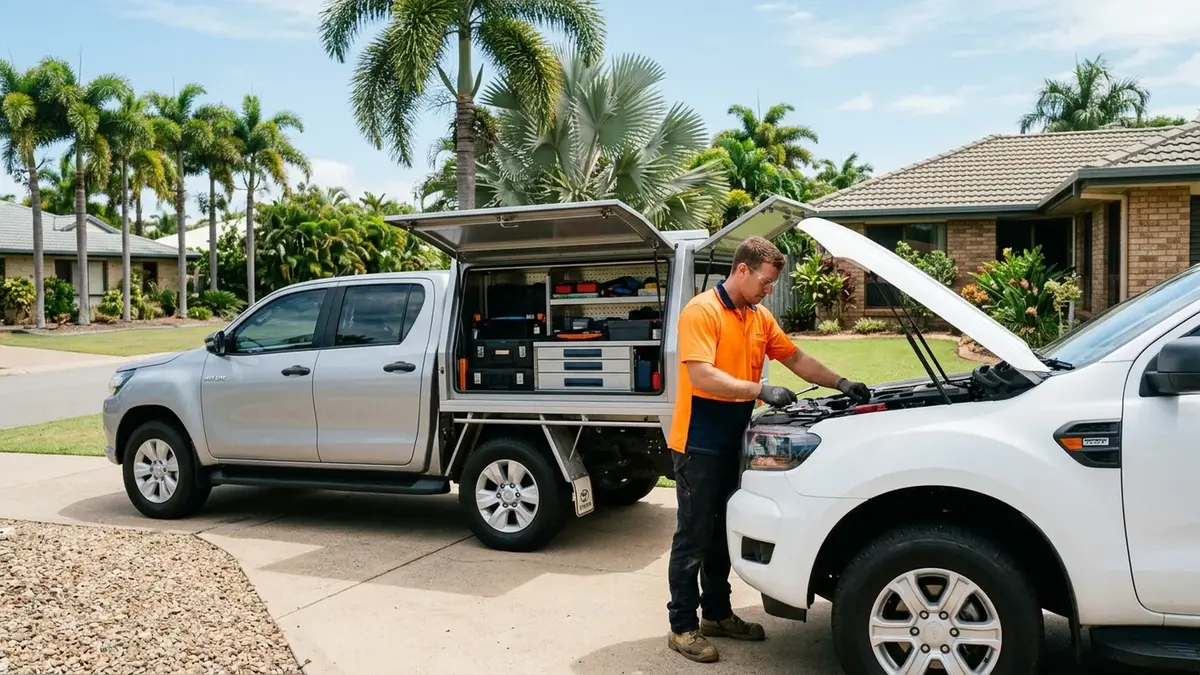
We Come to the Car
Tell us what you need done. We'll assess the job, explain your options and provide a clear quote.
No obligation · Clear scope before work starts
Get a free quote
A few details are all we need to get started.
Typical call-out fee
$50-$100, plus labour generally $80-$150/hr
Logbook service range
$180-$500 depending on vehicle and interval
Warranty
ACCC confirms independent logbook servicing keeps your new-car warranty
What we do
Mobile Mechanic services in Townsville
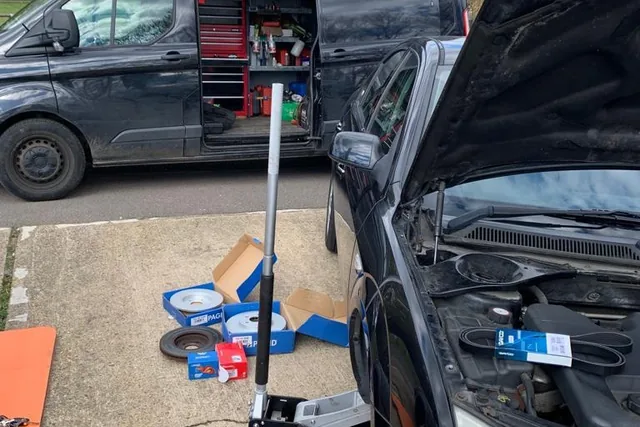
Breakdown & Won't-Start Callouts
Car dead in a Townsville driveway, work carpark or shopping centre? We diagnose it and, where possible, fix it where it sits - no tow needed.
View service →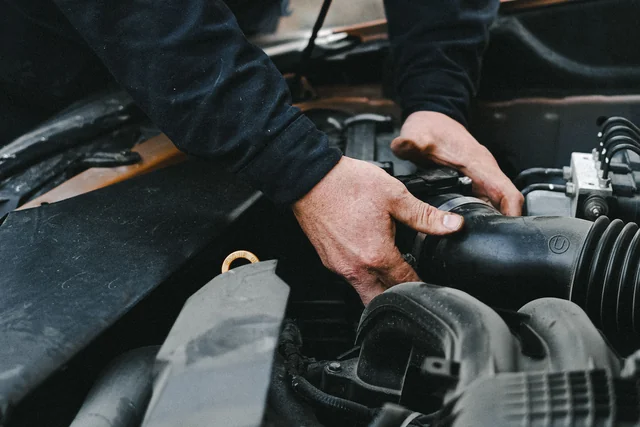
Warranty-Safe Logbook Servicing
Scheduled logbook servicing done in your driveway or work carpark. Under Australian Consumer Law a qualified independent mechanic can stamp your logbook without voiding a new-car warranty.
View service →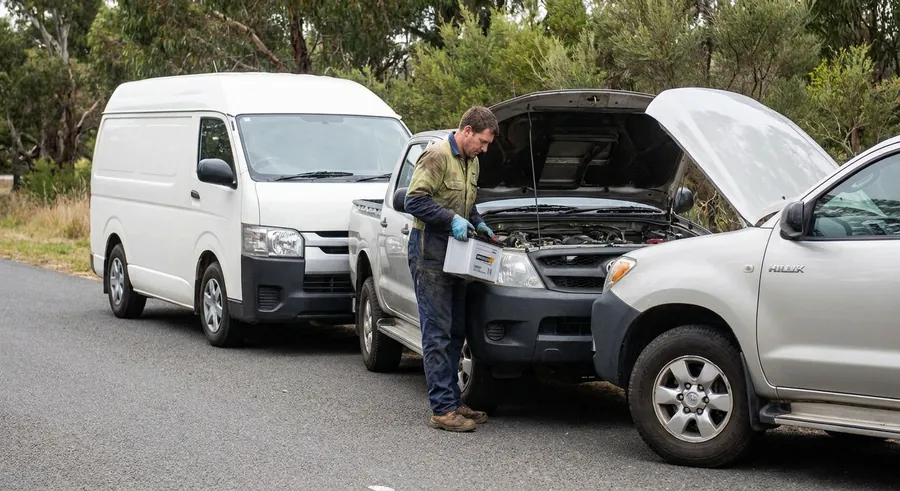
Mobile Car Battery Replacement
Need car battery replacement in Townsville? We test the battery and charging system on site, then fit a correctly rated replacement where the car is parked if the battery is the fault.
View service →Brake Repairs & Pad Replacement
Grinding, squealing or a spongy pedal? We measure pad and rotor wear at your address and replace pads and discs on site.
View service →Pre-Purchase Vehicle Inspections
Buying privately in Townsville? We inspect the car at the seller's address and give you a written report before you hand over money.
View service →Mobile Diesel Mechanic
Utes, 4WDs and light commercials. DPF blockages, injectors, glow plugs, turbos and diesel servicing, done where the vehicle is parked.
View service →Getting started
From your first enquiry to the finished job
- 01
Tell us what the car is doing
Make, model, and whether it cranks, clicks or is completely dead. That decides which parts go on the van before we leave.
- 02
We come to the car
Home driveway, work carpark or wherever it stopped. You do not need to be there for every job - we confirm access when you book.
- 03
Test and diagnose on site
Battery and charging system under load, scan tool for stored and pending codes, then the mechanical checks the symptom points to.
- 04
Fix it, or put it in writing
Most faults are repaired in the same visit. Anything that genuinely needs a workshop gets a written diagnosis so your next decision is an informed one.
About our work
Mobile mechanical work across Townsville
We work on cars where they are - in driveways, in work carparks, and on the side of the road when something has stopped. That covers most of what a car actually needs: logbook servicing, brakes, batteries and charging systems, starters and alternators, cooling system work, diagnostics, and pre-purchase inspections before you buy someone else's problem.
More about how we work
Townsville shapes the work. Heat is the big one, and it shows up most in batteries and cooling systems - a battery here does not get the four to five years the manufacturer's marketing assumes. Coastal humidity and salt air are the second, which is why underbody corrosion gets real attention on a pre-purchase inspection here in a way it might not in an inland market. A car that has spent its life near the beach can look immaculate from a walk-around.
The part that matters most is testing before replacing. Load-testing a battery rather than reading its voltage, measuring pad and disc thickness rather than eyeballing them, checking the alternator before fitting a new battery. It is slower than swapping the obvious part, and it is the difference between fixing the fault and seeing the same car again in three months.
- Home driveway, work carpark or roadside - the car does not move first
- At your address
- Australian Consumer Law keeps your new-car warranty when an independent services it
- ACL
- You get the diagnosis documented, whether we fix it on the spot or not
- In writing
- A diagnosis before you pay to move the car anywhere
- No blind tow
The car does not have to move first
The one thing a dead car cannot do is drive to a workshop, which is the whole reason this service exists. Most of what a car needs - servicing, brakes, batteries, alternators, starters, cooling system work and diagnostics - needs hand tools and jack stands rather than a hoist. Doing it where the car already sits removes the tow, the drop-off, the courtesy car and the day off work, and for a no-start it is usually cheaper than the tow alone would have been.
Heat is the local variable
Townsville is hard on cars in ways a southern workshop does not see daily. Sustained tropical heat accelerates the chemistry inside a lead-acid battery, drives electrolyte loss and corrodes plates and terminals, so batteries that manage four to five years in a temperate climate routinely fall short here. Constant air-conditioning load adds to it, and coastal humidity and salt air attack underbody metal. We test with that in mind rather than working off averages from somewhere cooler.
We test the charging system, not just the battery
A battery that failed early usually had help. An alternator undercharging it, or a parasitic drain flattening it overnight, will kill a brand new battery the same way it killed the old one. Selling you a battery without finding that fault buys a few months and returns the same problem, so alternator output and parasitic draw get tested as part of the job. If the battery tests good, we say so rather than replacing a part that is not the fault.
Your warranty stays intact
The thing that stops most people using an independent for a logbook service is the warranty question, and the ACCC has been explicit on it. Under Australian Consumer Law you are not required to service at an authorised dealer to keep your manufacturer warranty, provided the work is done by appropriately qualified staff, to the manufacturer's specifications and intervals, with parts suitable for the vehicle. They do not have to be genuine branded parts. We stamp the book and the warranty stands.
We tell you what needs a workshop
Some jobs genuinely cannot be done in a driveway. Internal engine and transmission rebuilds, clutch replacement on a lot of vehicles, wheel alignments and rotor machining all need a hoist or a lathe. Pretending otherwise wastes a callout fee. What we can do is diagnose it properly on site and give you that in writing, so if the car does need to go somewhere you are moving it knowing what is wrong rather than paying for a tow and a workshop diagnostic to find out.
You get the diagnosis in writing
Whether we fix it on the spot or find something that needs a workshop, what we found goes to you in writing. That report is worth having: it is what stops you paying for a blind tow, and it is leverage if you are deciding whether a car is worth keeping or buying.
No work starts without an agreed price
You will know the price before anything is touched. If the job opens up and turns out to be more than the symptom suggested - a seized calliper slide behind what looked like a simple pad wear job - we stop and talk to you rather than continuing and adding it to the invoice.
We will tell you when it is not worth fixing
Sometimes the honest answer is that the repair costs more than the car is worth, or that the fault is the third symptom of something terminal. You will get that answer straight. It costs us the job and it is still the right call, particularly on an older vehicle where the next fault is already queued up behind this one.
Planning your job
Common mobile mechanic questions
How much does a mobile mechanic cost in Townsville?
Mobile mechanics across Australia typically charge a call-out fee of $50-$100 to cover travel and initial diagnosis, plus labour generally in the $80-$150 per hour range, with parts on top. A completed job commonly lands around $180-$220, a logbook service $180-$500 depending on the vehicle, and a basic oil and filter change $80-$180. There are no fixed industry rates, so pricing varies with urgency, day of the week and job complexity. We quote before we start, so you are not agreeing to an open hourly rate and hoping.
Will servicing with a mobile mechanic void my new car warranty?
No. The ACCC has confirmed that under Australian Consumer Law you are not required to service at an authorised dealer to keep your manufacturer warranty. An independent mechanic can carry out and stamp your logbook service, provided they are appropriately qualified, follow the manufacturer's specifications and service intervals, and use parts suitable for the vehicle - the parts do not need to be genuine branded parts.
What can't be done in my driveway?
Most servicing, brake work, batteries, alternators, starters, cooling system work, suspension components and diagnostics are routine mobile jobs. What needs a workshop is anything requiring a hoist, a machining lathe or specialised equipment - internal engine and transmission rebuilds, clutch replacement on many vehicles, wheel alignments and rotor machining. We can still diagnose those on site so you know what you are dealing with before committing to a tow.
What should I have ready when I call about a breakdown?
The make, model and rough year of the car, and exactly what it is doing - whether it cranks but will not fire, clicks once, or is completely dead. That distinction narrows the likely fault before we leave and decides which parts go on the van, which is frequently the difference between fixing it on the first visit and having to come back. Tell us where the car is sitting and whether we can get to it, because a home driveway, an open work carpark and a tight underground bay are three different jobs. If it has been jump-started recently, or it sat unused through a hot week, mention that too - both change what we test first.
Where we work
Townsville & surrounding communities
See all Townsville service areasTownsville suburb by suburb
Where a car stops changes the job as much as what is wrong with it - access, shade and how far we are carrying tools all matter before anything gets diagnosed.
Kirwan and Kelso cover a lot of the Upper Ross and the Thuringouwa Drive corridor, and between them they generate most of the residential driveway work - no-starts, batteries and servicing at home. They are also where the carpark callouts cluster, around Willows Shopping Centre in particular. A precise location helps more than people expect: a shaded home driveway and an exposed shopping centre bay in the middle of a Townsville afternoon are genuinely different working conditions.
Aitkenvale and Idalia sit either side of the Ross River Road retail spine, taking in Stockland Townsville and the Fairfield Waters development. This is heavy stop-start driving with constant air-conditioning load, which is exactly the duty cycle that punishes batteries and brakes. Short trips never fully recharge a battery, and a battery that is chronically undercharged fails early even when the alternator is fine.
Douglas is dominated by the James Cook University and Townsville Hospital precinct, which means large staff and student carparks and a lot of cars that sit through long shifts in the heat. Shift work is the reason a lot of that suburb's servicing gets done mobile - the car is stationary for eight hours anyway, and it does not need its owner standing next to it for most jobs.
Annandale runs along the south bank of the Ross River, and Deeragun sits out on the northern side towards the Bruce Highway. Deeragun in particular is where the distance matters: it is far enough out that a wasted callout is expensive for everyone, so the more precisely you can describe the symptom before we leave, the better the odds of the right parts being on the van the first time.
Before work begins
Why Townsville is harder on cars than the service schedule assumes
Manufacturer service intervals are written for an average climate. Townsville is not one, and the gap shows up in a few specific components.
The clearest example is the battery. A lead-acid battery is a chemical device, and chemical reactions accelerate with temperature. Sustained heat drives electrolyte loss, corrodes the plates and attacks the terminals, all of which cut usable capacity. The four to five year life people expect from a car battery is a temperate-climate figure, and batteries in consistently hot cities routinely fall well short of it. Add the electrical load of air-conditioning running almost year-round and the demand on the charging system is higher here than the design case.
That interacts badly with short-trip driving. A battery is recharged by the alternator over time at speed, and a pattern of short runs around Aitkenvale or Kirwan never fully replaces what starting the car took out. The battery sits chronically undercharged, which accelerates sulphation and shortens its life further. This is why a battery can fail early with a perfectly healthy alternator, and why the fix is sometimes a charging habit rather than a part. The same duty cycle catches diesels a different way: a DPF needs sustained exhaust temperature to burn off the soot it traps, and a run to the shops and back never gets there.
Cooling systems are the second pressure point. Coolant does not last indefinitely - the corrosion inhibitors in it deplete, and once they do the system starts attacking itself from the inside, usually showing up first as a weeping hose joint or a radiator that has quietly lost efficiency. In this climate a cooling system runs closer to its limit more of the time, so a marginal one fails here in traffic where it might have survived elsewhere.
Third is corrosion, which matters most when you are buying rather than running. Salt air and humidity attack underbody panels, chassis rails, suspension mounts and body cavities far faster on the coast than inland, and almost none of it is visible from a walk-around. A car that looks immaculate on top can be significantly worse underneath, which is the single strongest argument for getting a pre-purchase inspection that actually puts the vehicle up and looks.
When a mobile mechanic is the sensible first call in Townsville
A mobile mechanic is useful when the car cannot move, when moving it is the expensive part, or when the job can be completed where it is parked.
The obvious case is a no-start. If the battery is flat, a terminal is corroded, a relay has failed or the alternator is not charging, towing the car to a workshop before anyone tests it adds a second cost without fixing the first problem. A mobile mechanic can load-test the battery, check the charging system and scan for stored faults where the car stopped. If the repair needs only a battery, terminal, fuse, relay or starter diagnosis, there is no reason to make the vehicle move first.
Scheduled work is the other good fit. A logbook service, brake inspection, battery replacement or pre-purchase inspection does not need a workshop hoist to begin. The useful question is whether the job needs specialist equipment: wheel alignments, rotor machining, internal engine work and major transmission repairs do. We say that early rather than pretending every problem belongs in a driveway.
Townsville's heat changes the triage. A battery that has started cranking slowly, or a cooling system that is running hotter in traffic, is worth checking before it becomes an after-hours carpark problem. In suburbs such as Kirwan, Aitkenvale, Douglas and Annandale, the practical advantage is simple: the car can be assessed in the driveway or work carpark while it is already stationary. Describe the symptom, vehicle and exact location when you enquire so we can arrive prepared to test the right system.
Servicing outside the dealer without losing your warranty
The belief that you must service at the dealer to keep a new-car warranty is the single most expensive misconception in car ownership, and the ACCC has addressed it directly.
Under Australian Consumer Law you are not required to have your vehicle serviced by an authorised dealer to keep your manufacturer's warranty. An independent mechanic can carry out and stamp your logbook service, and the warranty remains intact, provided three things are true: the work is done by appropriately qualified staff, it follows the manufacturer's specifications and service intervals, and the parts used are suitable for the vehicle. Importantly, those parts do not have to be genuine manufacturer-branded parts.
This holds even where the logbook page itself is printed with spaces labelled for an authorised dealer. The label is not a legal requirement, and an independent repairer can sign and stamp that page. What matters is that the scheduled work was actually carried out to specification and recorded. If a dealer refuses warranty coverage purely on the basis that an independent did the servicing, that is a matter the ACCC can be contacted about on 1300 302 502.
The practical requirement is that the service is the right one. A logbook service is not a generic oil change - it follows the manufacturer's schedule for your specific vehicle at that specific interval, which is why a 40,000km service is a substantially bigger job than a 10,000km one. Depending on where the car sits, that can mean engine oil and filter, air and cabin filters, spark plugs, brake fluid, coolant condition, transmission and differential oils, belt and hose inspection, brake and tyre measurement, a suspension and steering check and a road test.
Done mobile, the whole thing happens while the car is parked at home or at work. Because the schedule is known in advance, it can be quoted accurately before the visit, including the specific oil and filters your vehicle takes - which also makes it straightforward to compare against a dealer quote line by line. Keep the stamped book and the itemised invoice together; that record is what protects the warranty and what supports the price when you sell.
What actually moves the price of a mobile job
There are no fixed industry rates for mobile mechanical work, so it is worth knowing which variables genuinely move a quote and which do not.
The baseline is a call-out fee, generally $50 to $100 across Australia, covering travel and the initial diagnosis, with labour on top typically in the $80 to $150 an hour range and parts separate. A completed job commonly lands around $180 to $220. A logbook service runs roughly $180 to $500 depending on the vehicle and which interval is due, and a basic oil and filter change $80 to $180. European vehicles, longer intervals and anything including spark plugs or transmission fluid sit at the top of those ranges.
The first real variable is whether the fault is what the symptom suggested. A no-start that turns out to be a battery is the cheapest possible outcome - one visit, one part, no tow truck. The same symptom caused by a starter motor, a wiring fault or an immobiliser problem is a longer diagnostic job. This is why describing the symptom precisely when you book genuinely saves money: it decides what goes on the van, and a job finished on the first visit costs less than one that needs a second.
The second is timing. After-hours, weekend and genuinely urgent callouts attract a premium, and that is worth planning around where the fault allows. A battery that is cranking slowly is telling you it is going to fail, and replacing it on a weekday morning is materially cheaper than replacing it at nine on a Sunday night in a carpark. Brakes that have started squealing are the same - the squeal is the wear indicator doing its job, and acting on it beats acting after it turns into grinding and takes the discs with it.
The third is what a low quote has quietly excluded. On brakes, an unusually cheap price usually means pads fitted onto discs that are past minimum thickness, which chews the new pads out early and costs more over the life of the car. On a battery it often means no charging-system test, which is the test that determines whether the new battery will last. On a pre-purchase inspection it usually means visual-only with no scan tool, which misses stored and recently cleared fault codes - exactly what a seller with something to hide would clear before you arrive.
Let's talk about your job
Clear advice. A written scope. No obligation.